
Unity of Opposites
Journal Lessons
Life is full of contradictions
Rav Kook and the principle of unity: why the things that look most opposite often share a single source, and how we can learn to hold them.
Lesson 1:
Rav Kook's Unity of Opposites
All reality is one harmonious whole
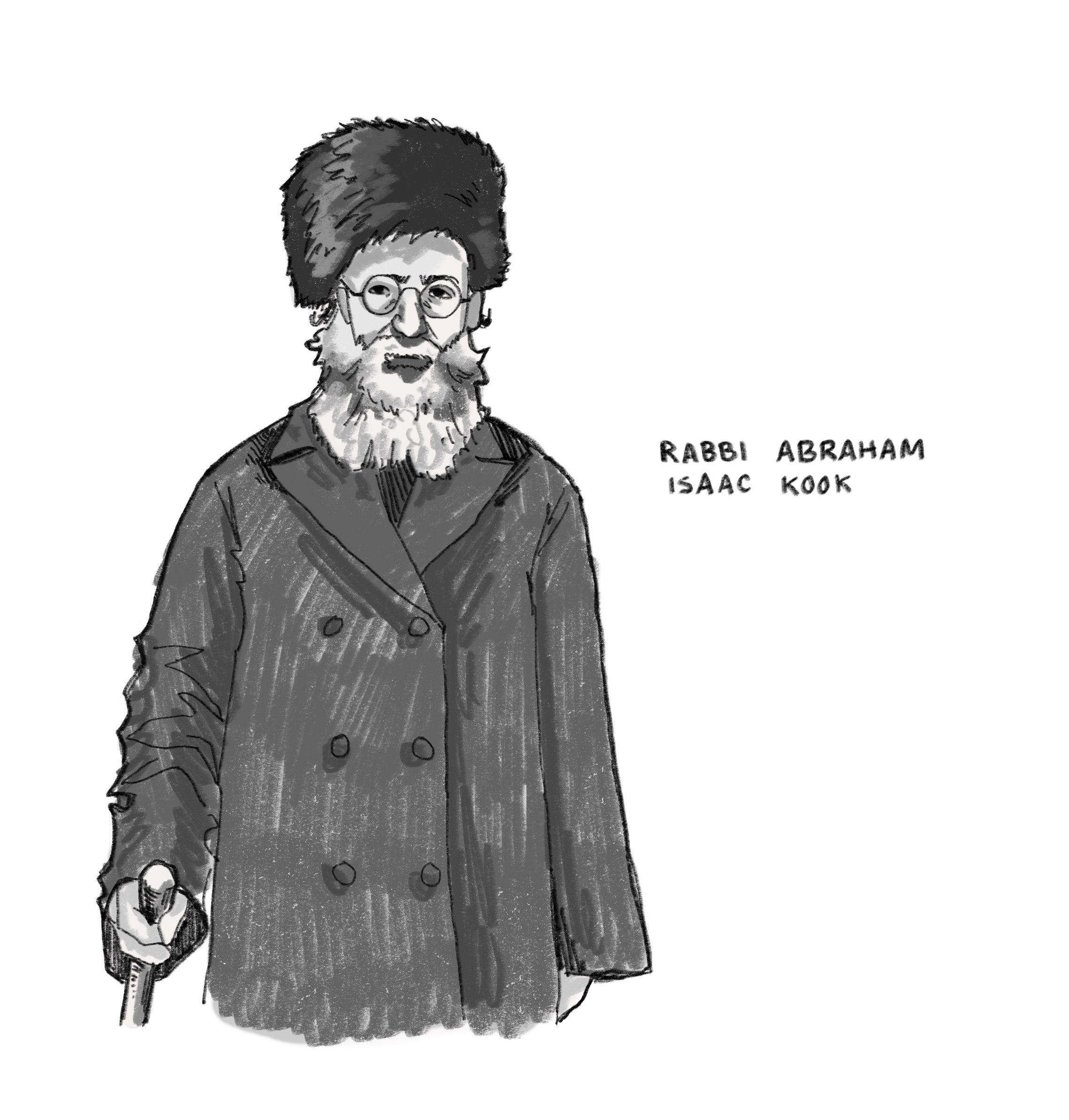
Rabbi Abraham Isaac Kook, the first Ashkenazi Chief Rabbi of the Land of Israel, built his whole philosophy on one assumption: everything has its source in the divine. Scholars call it the principle of unity.
It made him unusually open to ideas that weren't his own. He believed every idea speaks to the truth in some way.
"Truth is too great, too rich, and too multifaceted to be grasped or exhausted by any one particular theory."
Lawrence Kaplan and David Shatz, quoted in David Singer, "Rav Kook's Contested Legacy"
Are we still one people?
With all of our disagreements, it doesn't always feel that way. Here are a few beliefs held by Jews around the world today. Notice which ones make your chest tighten.
"Our mission as Jews is to share the universal values of Torah with the world."
vs"Jews are a particular nation, distinct from those around us."
"Israel is a Jewish state, and should be ruled by Jewish law."
vs"Israel is a liberal democracy, and must embrace its secular and minority populations all the same."
"Judea and Samaria are the biblical heartlands of Israel, and they are Jewish."
vs"Israel should shut down all illegal settlements and end the military occupation of the West Bank."
"Ultra-Orthodox Jews should be exempt from the IDF draft because they are devoted to Torah learning."
vs"Ultra-Orthodox Jews benefit from the military service of secular Israel without having to sacrifice anything."
He lived through the deepest disagreement of his time
For centuries, Jews prayed every day to return to Zion, and most believed only the Messiah could bring us home. When modern political Zionism arose in the late 19th century, many rabbis denounced it as a secular project that would pull Jews away from observance.
Rav Kook became one of the most influential rabbis to embrace it anyway.
Talmud scholars in Europe, rabbis in Iraq, and secular pioneers in Palestine were all part of the same divine story.
At least, that's how Rav Kook saw it.
Opposite colors, same light
No two colors could be more different than white and black, yet both are a reaction to the same source. White reflects every color of light. Black absorbs every color of light.
The things that look most opposite often share a single source.
That's the heart of Rav Kook's principle of unity.
Each of us adds light to the whole
In Orot, Rav Kook describes how the individual (prat) and the collective (klal) give life to each other.
הנשמה של היחידים נשאבת ממקור חי העולמים באוצר הכלל, והכלל נותן נשמה ליחידים.
"The soul of the individuals is drawn from the source of eternal life in the treasury of the klal, and the klal gives soul to the individuals."
Rav Kook, Orot, Orot Yisrael 2:3The collective soul, he writes, rises through "the added light that the prat brings to it."
Unity never asks us to disappear.
Unity is a skill
Most of us handle contradiction in one of two ways:
- We run from it: we mute, unfollow, and change the subject.
- Or we dismiss it, deciding the other side is foolish or dangerous.
Both feel safe, and both keep us from seeing the whole picture.
Our brains are wired to treat disagreement as a threat. The good news is that the brain changes with use.
The same part of the brain that helps us work through contradictions also helps us feel empathy. So every time we sit with an opposing view a little longer, we get better at seeing the world through someone else's eyes.